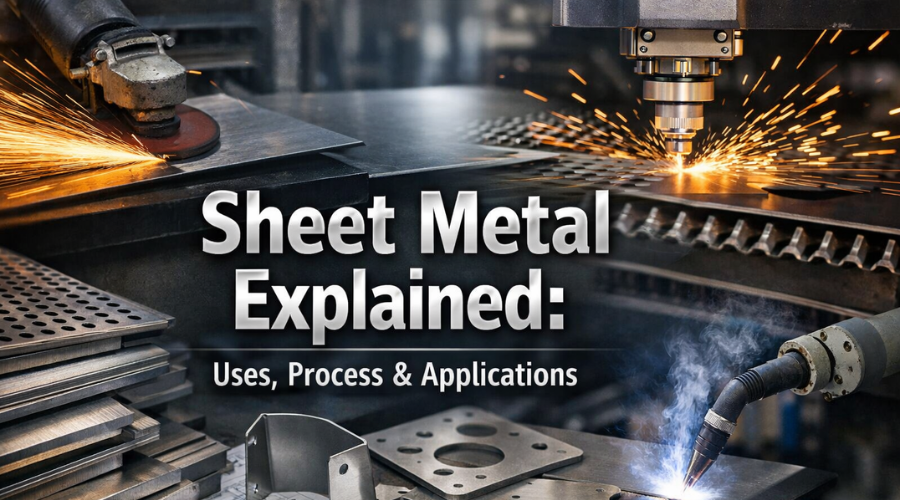
Sheet metal is one of those everyday engineering heroes — it’s everywhere, from the toaster on your kitchen counter to the body panels of a car, the ductwork in buildings, and the delicate enclosures of medical devices. This guide will walk you through what sheet metal is, the materials and processes used to shape it, the real-world applications across industries, and practical design tips so your next sheet metal part performs well and stays cost-effective. I’ll keep it conversational, practical, and stuffed with the kind of detail fabricators and designers actually care about. Let’s dive in.
At its simplest, sheet metal is flat metal formed into thin, typically uniform-thickness pieces. Thicknesses range from very thin foil to heavy-gauge plates. In everyday terms:
Common sheet metal materials include steel (cold-rolled, hot-rolled, galvanized), stainless steel, aluminum, copper, brass, and titanium. Each offers different strength, corrosion resistance, weight, and cost profiles — which we’ll cover below.
People choose sheet metal because it’s:
But it’s not a silver bullet; sheet metal also has constraints (tolerance limits, tooling needs, springback) that we’ll address.
When choosing, balance strength, weight, corrosion resistance, formability, and cost.
There are many ways to turn flat sheet into useful parts. Below are the most common sheet metal manufacturing and fabrication processes.
Shearing is the fastest way to cut straight edges. Modern shops use CNC shear lines or robotic shears for high throughput. For complex contours, use laser cutting, waterjet, or plasma cutting.
Laser cutting provides high precision, clean edges, and is excellent for thin to medium gauges. It’s fast for intricate profiles and low-volume production because it requires no physical tooling.
Waterjet cuts any material (including composites) without heat-affected zones. It’s slower than laser but great for thicker metals or materials sensitive to heat.
Punch presses stamp holes or shapes using punch-die sets. Extremely fast for repetitive features; tooling costs increase with complexity but are justified at volume.
A press brake bends sheet along straight lines using a punch and die. Key design factors: bend radius, K-factor, flange length, and springback.
Stamping is the rapid forming of shapes via dies (progressive or transfer). Deep drawing forms deeper parts (like cups, enclosures) and can produce hundreds of thousands of parts cost-effectively — but tooling costs are high.
Rolling creates curves and cylinders. Tube rolling and seaming are used for pipes and ductwork.
MIG/TIG welding, spot welding, resistance welding, riveting, and adhesive bonding are common. Choice depends on material compatibility, required strength, aesthetics, and thermal effects.
Finishes include painting, powder coating, anodizing (aluminum), plating (zinc, chrome), passivation (stainless steel), and mechanical finishes (brushing). Finishes protect, improve appearance, and sometimes insulate.
Design choices directly affect cost and yield. Here are practical tips.
Using the same gauge across a part or product line reduces setup and inventory complexity.
Each material and thickness has a minimum recommended bend radius. Tight radii cause cracking; overly large radii raise tooling costs.
Standard hole sizes reduce the number of punches or tools required.
Internal corners are stress concentrators and can be hard to form; add fillets or relieve with small radii.
Keep holes/features away from bends — bending can distort holes and change dimensions.
K-factor predicts material stretching at bends — use it to get flat patterns right so parts fit after bending.
Folding tabs into enclosures or integrating stiffeners can cut assembly steps and fasteners.
Most metals spring back slightly after bending — tool compensation is necessary.
Tabs, slots, and captive fasteners speed assembly. Consider spot weld locations and access for tools.
Unreasonably tight tolerances massively increase cost. Ask your fabricator for realistic tolerances for the process you plan to use.
Bending — Using a press brake to create flanges and angles. Simple and economical.
Stamping — High-speed production using dies to punch and form parts in one or multiple strokes.
Deep drawing — Pulling sheet into a die to form deep parts without seams.
Burnishing & clinching — Methods to join without welding, useful for thin sheets and where heat would be harmful.
Hydroforming — Using pressurized fluid to form complex, seamless shapes — used in automotive and aerospace for contoured components.
Each technique has different strengths. For example, stamping is economical at scale but costly to set up; laser cutting is flexible and low setup cost but slower at very high volumes.
Pro tip: communicate which dimensions are functional vs aesthetic. Fabricators will often hold functional dimensions tighter if told what matters.
Choosing the right finish protects parts and sets the look.
Consider environment (outdoor, marine, chemical exposure), required lifespan, and cost when selecting finishes.
Major cost drivers include material choice, thickness, complexity of bends, number of operations (cutting, punching, forming, welding), tolerance tightness, finish, and production volume.
Ways to reduce cost:
One of sheet metal’s strengths is recyclability. Most metals can be recycled repeatedly without quality loss. To be greener:
Sustainability also impacts procurement — recycled aluminum and eco-certified steel may cost more or less depending on supply.
Selecting a fabricator is as important as your design. Ask for:
Also request references and samples. A good fabricator will also advise on DFM (design for manufacturability) improvements.
Planning ahead avoids costly tool changes and rework.
These trends slowly change design constraints and open new opportunities for performance and cost savings.
Q: What’s the difference between sheet and plate?
A: Sheet is thinner (commonly up to ~6 mm / 0.25 in). Plate is thicker and used for heavy structural applications.
Q: Can stainless steel be welded easily?
A: Yes, stainless steels are commonly welded (TIG/MIG/spot), but you must manage heat and post-weld finishes to avoid corrosion issues.
Q: Is laser cutting better than waterjet?
A: Depends. Laser is faster and more precise for thin/medium metals; waterjet handles thicker materials and avoids heat-affected zones.
Q: How do I reduce part cost?
A: Simplify geometry, standardize materials, minimize unique holes and bends, and design for nesting and efficient assembly.
Sheet metal is a foundational material system in modern manufacturing — flexible, recyclable, and adaptable to a vast range of uses from delicate electronics enclosures to heavy-duty structural panels. To get the most from sheet metal, designers need to understand material choices, forming processes, finish options, and how design decisions affect cost and manufacturability. Whether you’re prototyping with laser cut aluminum or launching a million-piece stamped component, the same principles apply: design smart, communicate clearly with your fabricator, and focus on what matters functionally. With those practices, sheet metal will continue to be an efficient, economical choice for products that need strength, precision, and long life.
The use of CNC machinery has transformed the manufacturing i...
READ FULL